De_Curtained Cities
ARCHITECTURE THESISADVISORS: PROF. ERIN PELLEGRINO + PROF. VAL WARKESPRING 2023This thesis explores the billboard as a dominant force shaping perception and behavior within urban environments, focusing on sites such as Times Square, Piccadilly Circus, and Shibuya Crossing. By examining both the visible screen and the often-over-looked spaces behind it, the work proposes speculative futures grounded in each site’s cultural, historical, and psychological context. Through narrative, the project reimagines billboards not just as surfaces of display, but as active architectural and social agents within the city.
-
![]()
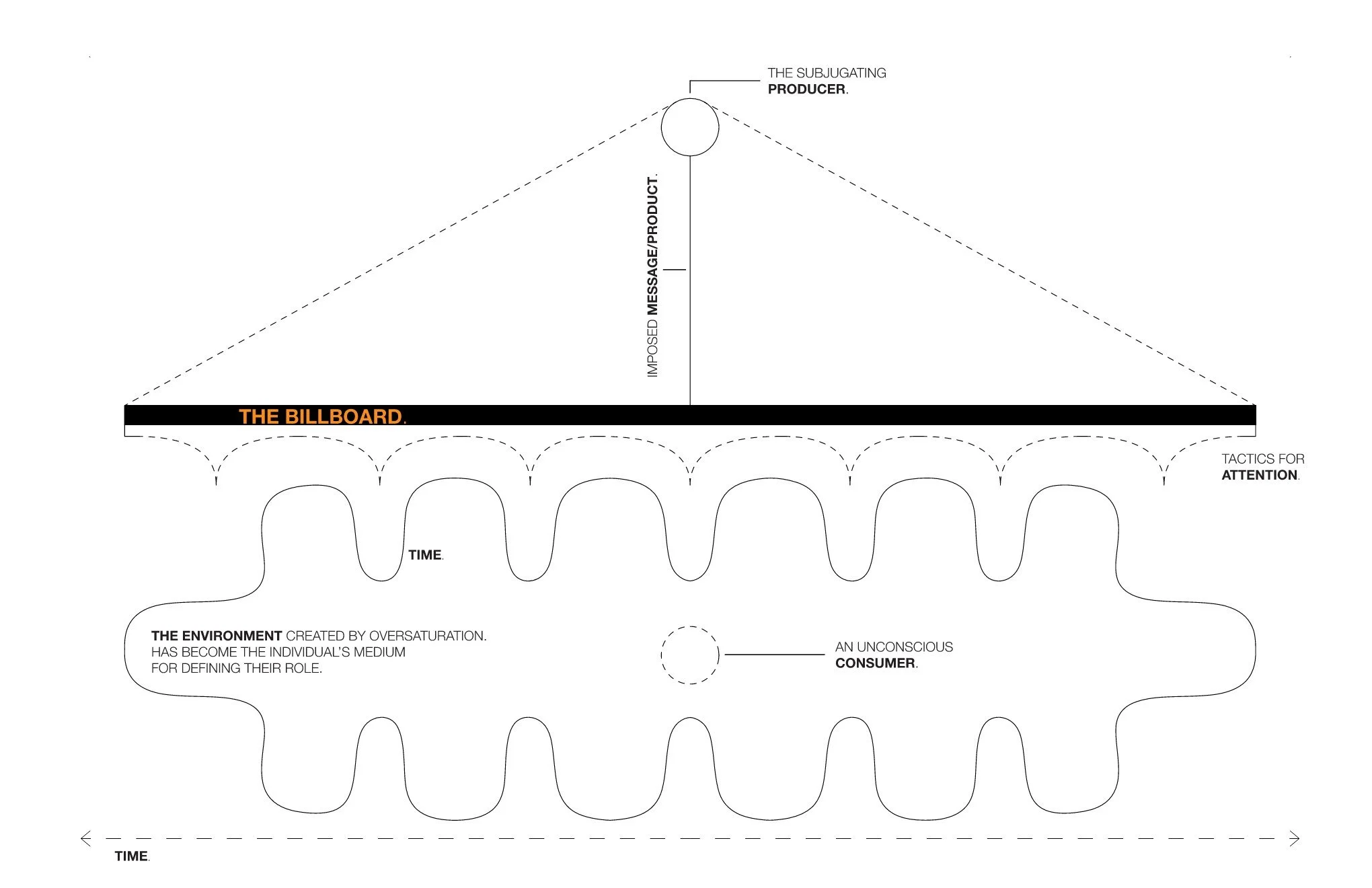
01 THE CURRENT RELATIONSHIP WE HANDLE WITH BILLBOARDS IS AS FOLLOWS.
There is a producer that is disseminating and imposing a message and/or product. There is the surface of every billboard that deploys tactics to garner attention. There is an environment that is oversaturated with text and image, in other words information, that has rendered us unconscious consumers.
-
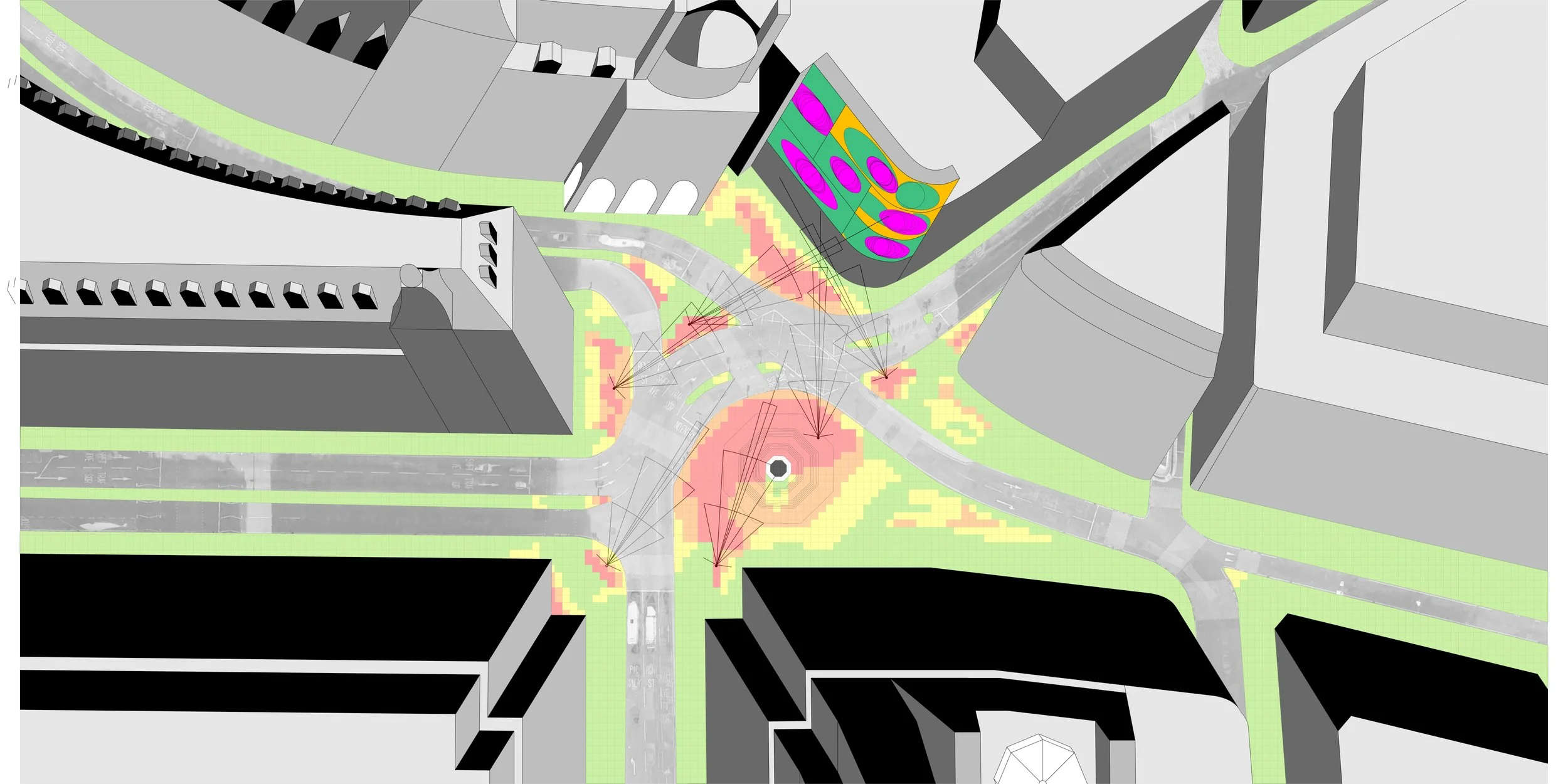
![]()
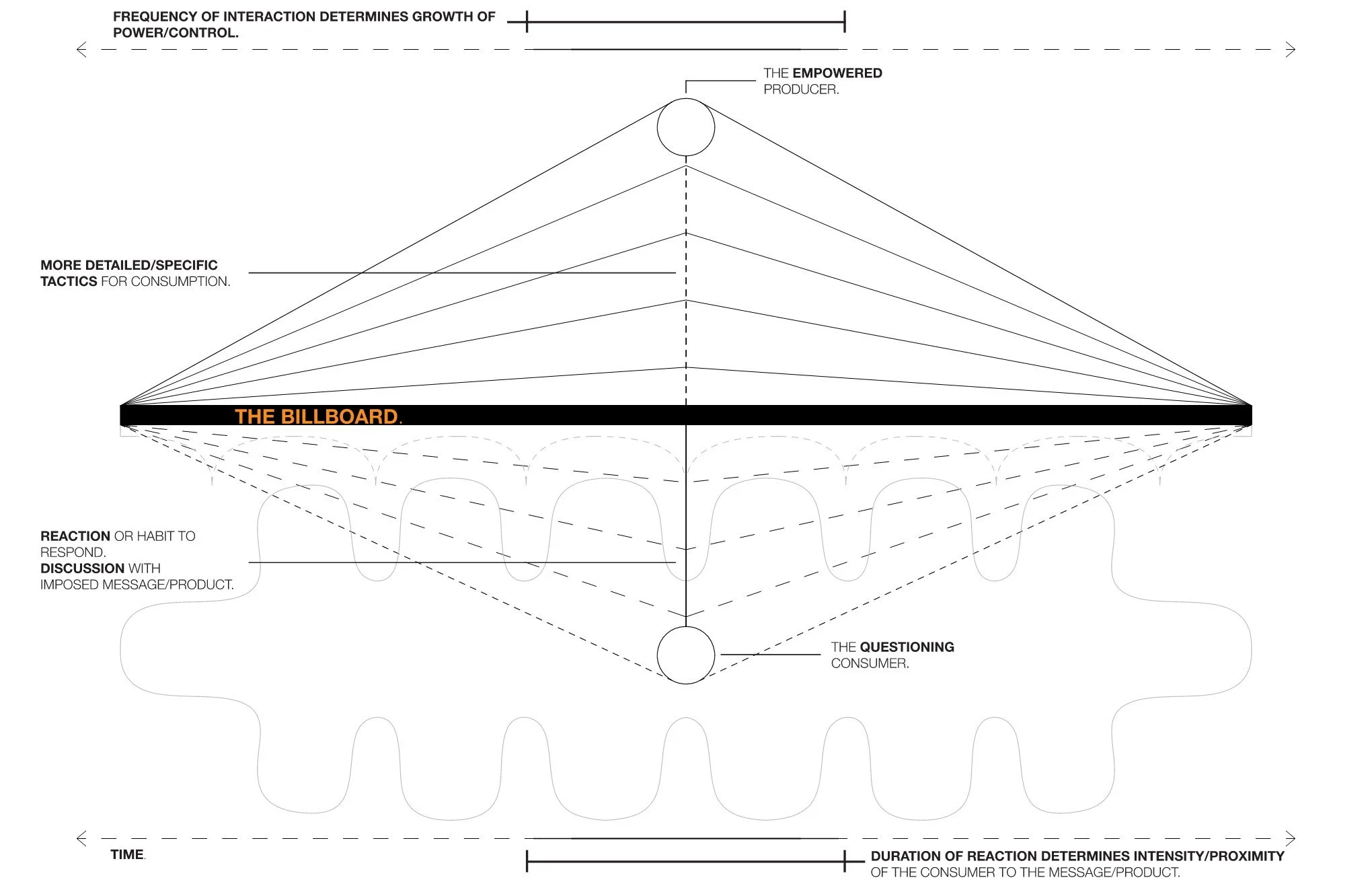
02 ONCE WE INTERACT WITH THE BILLBOARD TWO ROUTES CAN OCCUR. THEY ARE THE FOLLOWING.
We either question the billboard, have it separate us from ourselves, and have it impose its own biological, psychological, sociological, and cultural behaviors. In doing so, the time spent questioning the billboard determines the intensity of our connection [our want] with the message and/or product. In a directly proportionate manner, the time spent interacting with the billboard amplifies the producers tactics for attentions and hence increases their power and control over the unconscious consumer population.
-
![]()
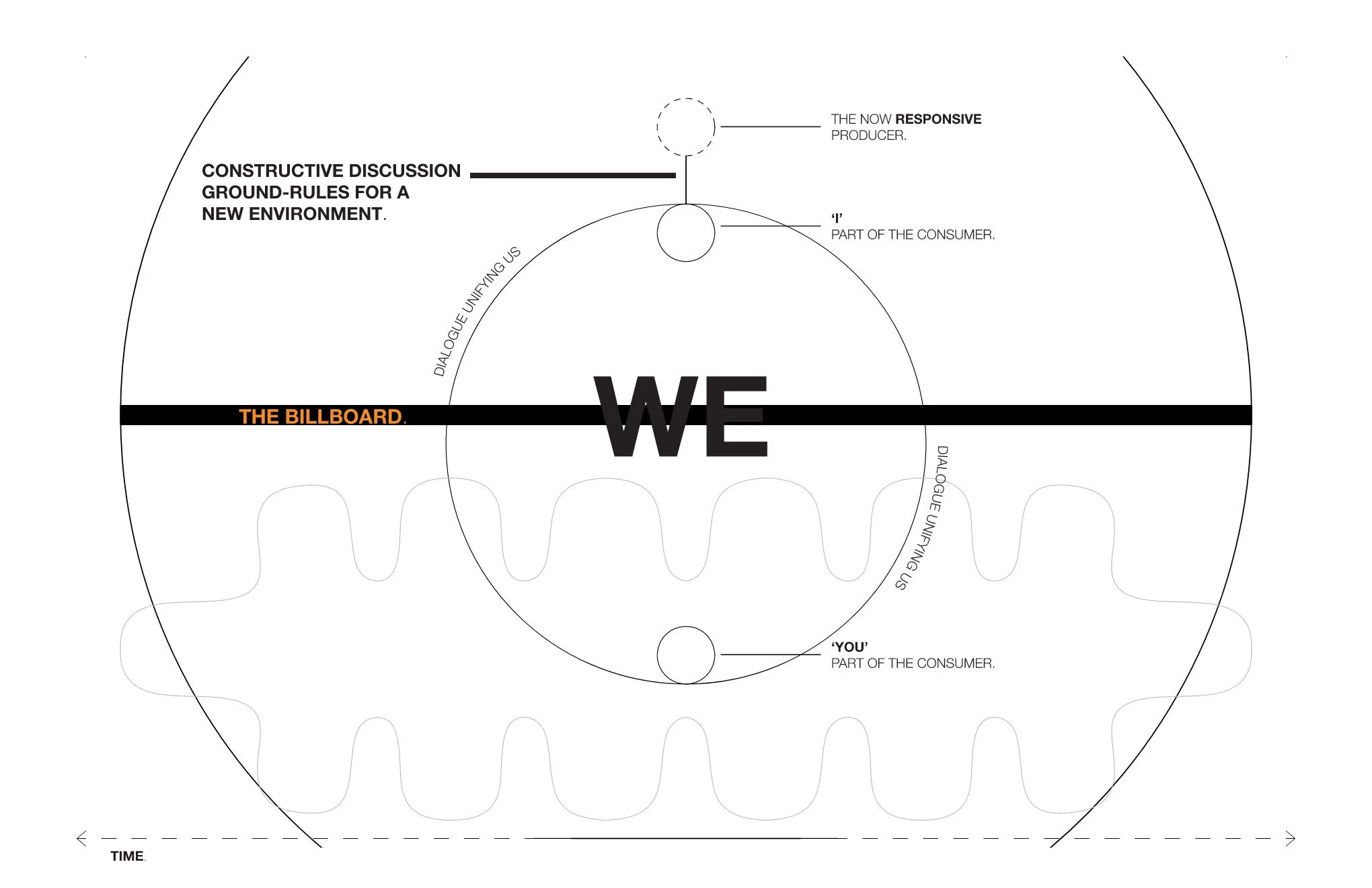
03 ...OR
We enter into a dialogue between ourselves, the “us” the producers are trying to tap into, and the producers themselves. In doing so, we are able to unite the two parts of ourselves, the “i” and the “you”, used by producers to control our reactions in space. The producers are then forced into a responsive dialogue that clarifies ground rules for the creation of a new environment, an anti-environment.
-
![]()
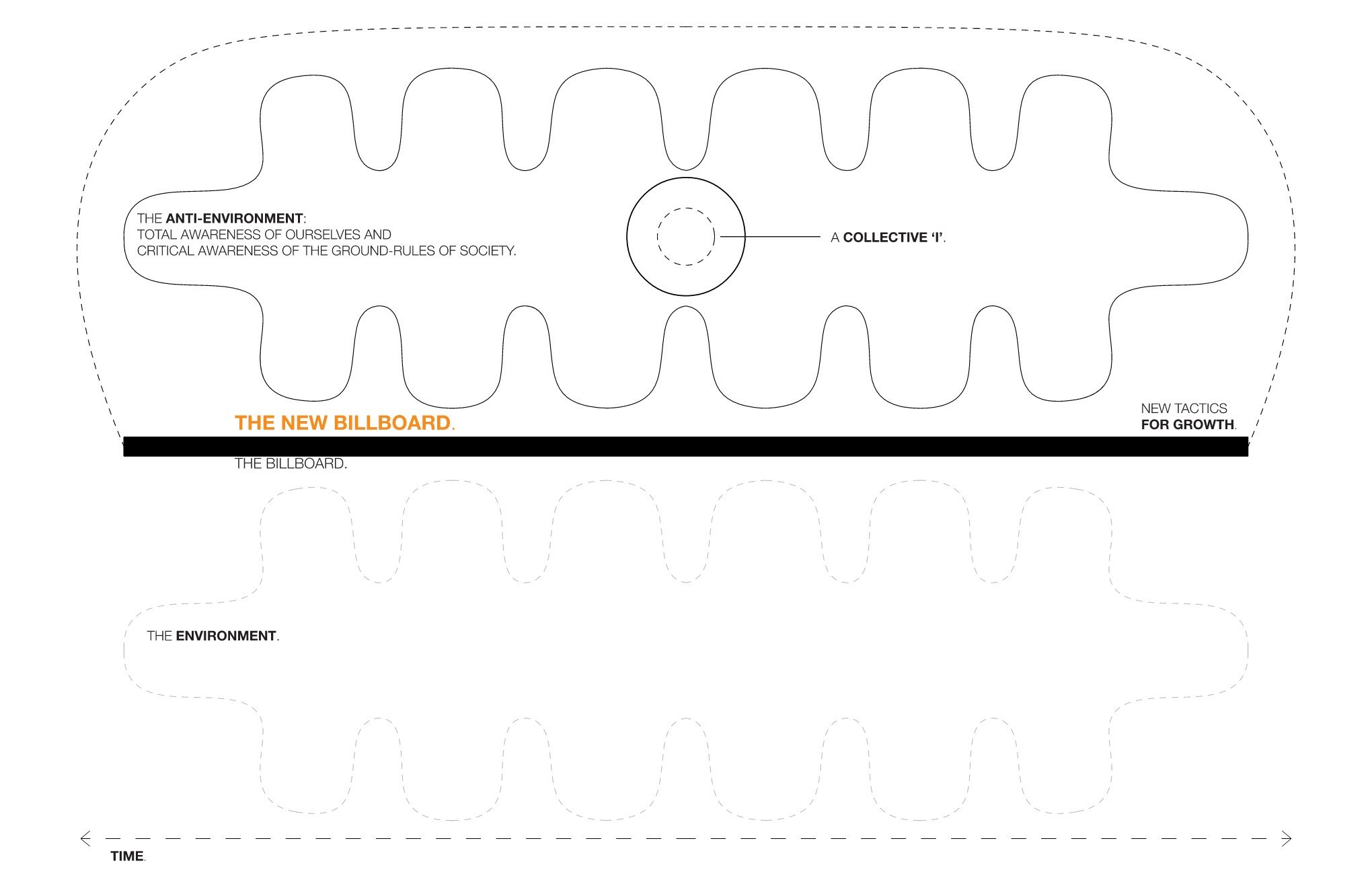
04 THIS LEADS US INTO THE POTENTIAL OF BILLBOARDS FOR THE FUTURE.
Post dialogue, the creation of an anti-environment is realized. A critical awareness of the ground rules of the producers and/or society.
The ex-environment is left behind and the new environment is fed by new tactics for growth that are developed by the very dialogue that joins “us” with ourselves and the producers.
-
![]()
05 THE ONE MEGA-SCREEN:
Piccadilly circus was the first site to be investigated for its unique quality of having a singular massive LED billboard. The entire circus functions as a whirlpool to draw attention to the texts and images plastered. The actual screen is subdivided into 6 separate regions, each separately owned by different companies. Each ad is rotated around each one of these regions on a periodical basis and hence giving no exact hierarchy between the companies. Eventually, within the periodic rotation, a single company gets the opportunity to rule the entirety of the screen. Each rotation to a different section of the ad alters the percentage of text, image and color that governs it. This forces each ad to then be customized to its given area and create another 6 customized ads. The curvature of the screen adapts itself to the urban design of the circus and its uni-focal plaza. As the main gathering point is around the Shaftesbury Memorial Fountain, the billboard is angled so as to have the majority of the billboard consumable from that point. However, by the shear size and bend it is able to capture audiences and spectators from every incoming pedestrian walk way. Additionally, the billboard has recently been retrofitted with new data collection technology that allows for it to record, detect, and recognize individuals and surrounding vehicles. This technology then personalizes the ads so as to make them more attractive, provocative, enticing, etc. For a generalized definition of the individual and/or car make.
-
![]()
06 THE HYBRID SCREEN:
Shibuya Crossing was the second site investigated as it is a spatial hybrid between the uni-focal Piccadilly Circus and the multi-focal Times Square. Shibuya has many more billboards than its English counterpart but still retains the main plaza urban design. This entails that the majority of its billboards are focused around said plaza rather than sprawling along a longer bow tie like structure to be discussed with Times Square. Additionally, Shibuya Crossing much like Piccadilly Circus is a transportation hub, but The Scramble, as it is nicknamed, sees a heavier movement of pedestrian traffic. The famous crisscrossing walkways see about 2,000-3,000 commuter every changing of the street lights. This not only makes more pedestrians take in the billboards but they are also more limited in the amount of time to do so. The ads rotate at a quicker pace than the Piccadilly ones do and as you will see in the heat mapping, the most concentrated areas tend to sprawl out more rather than have a clear focal point. This is due to the lack of lingering at Shibuya Crossing and the typical movements by commuters to get where they need to get to. Lastly, there is wider variety of billboard styles located at the scramble. Some are left outdoors while others are actually hung within building envelops. Others crawl along the building’s facades blocking windows and views, while other stack onto each other in order to reach higher points.
-
![]()
07 THE OMNIPRESENT SCREEN:
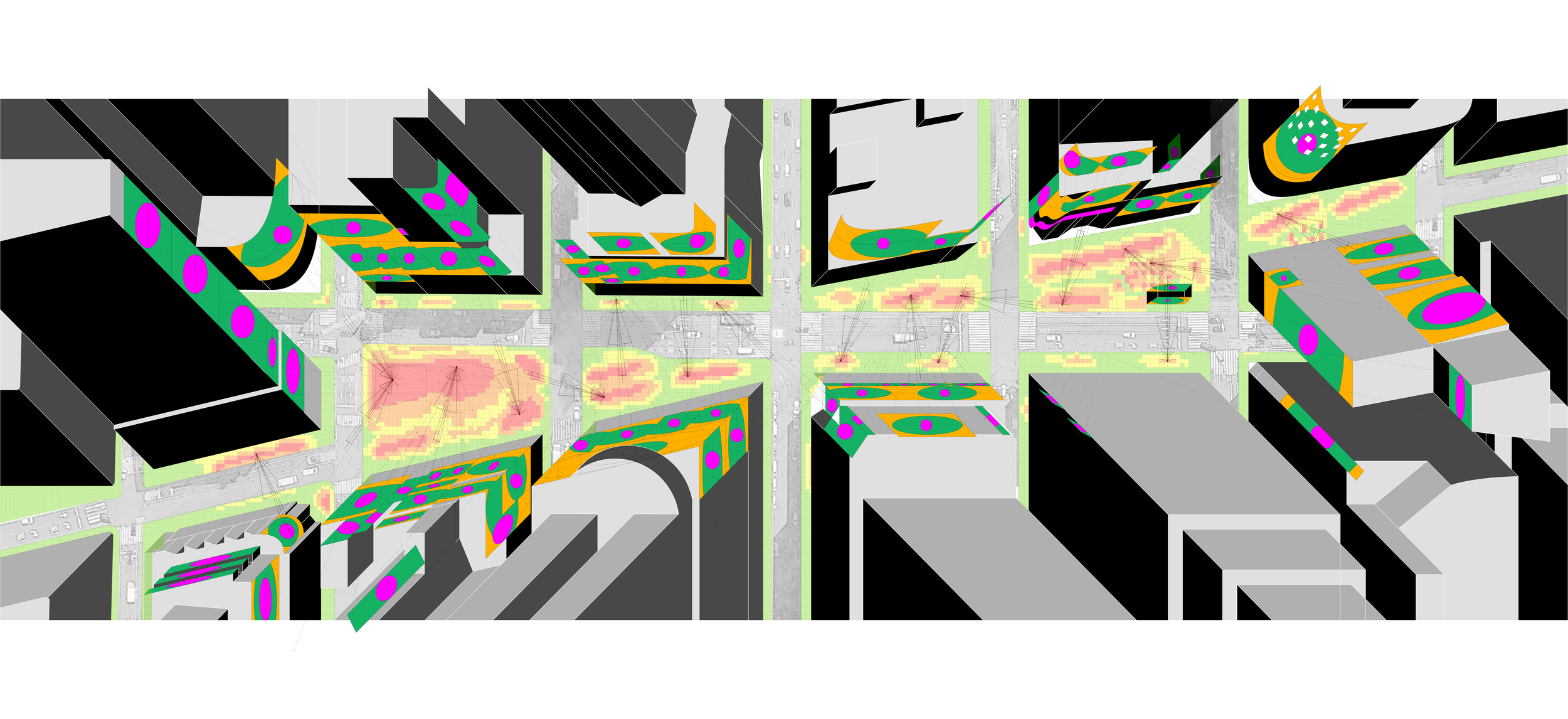
Times Square has historically been recognized for its brightness, derived from the tons of LED billboards that surround the site. While hosting more billboards than the previous two sites, Times Square also has a unique urban design. The plaza is shaped like a bow tie, which almost serves as a cue for where to view the entirety of the site from. The pinching forces a perspectival view that, in theory, divides the site in halves. Each site is capped off by vertical walls of screens that serve to encase the site. A similar perspective, yet mirrored in action, can be achieved by locating the larger plazas occupied by pedestrian space at the very ends of the bow tie. This creates a framed view of either half of the bow tie. Similar to Piccadilly Circus and in contrast to Shibuya Crossing, Times Square harbors a more lingering attitude with its pedestrians. Due to the intensity of the ads and its embodied ideas of consumerism, that are less present in the other two sites, Times Square has a really intense heat map. The pedestrians trying to make their way through the site are usually relegated to the very boundaries of the walkways while almost the entirety of the pedestrian space is left to taking in the surroundings. Although it is also a transportation hub, locals of the area tend to avoid its path due to the hoarding of people. Lastly, Times Square places its billboards in a significantly higher situation in regards to the previous two sites. This height and scale adds an additional line of dialogue between the billboards and those occupying spaces countless floors above.
-
![]()
08 DIGITAL DEGRADATION
VICIOUS CYCLES OF VICE AND ORDER
TIMES SQUARE, NEW YORK CITY, USA
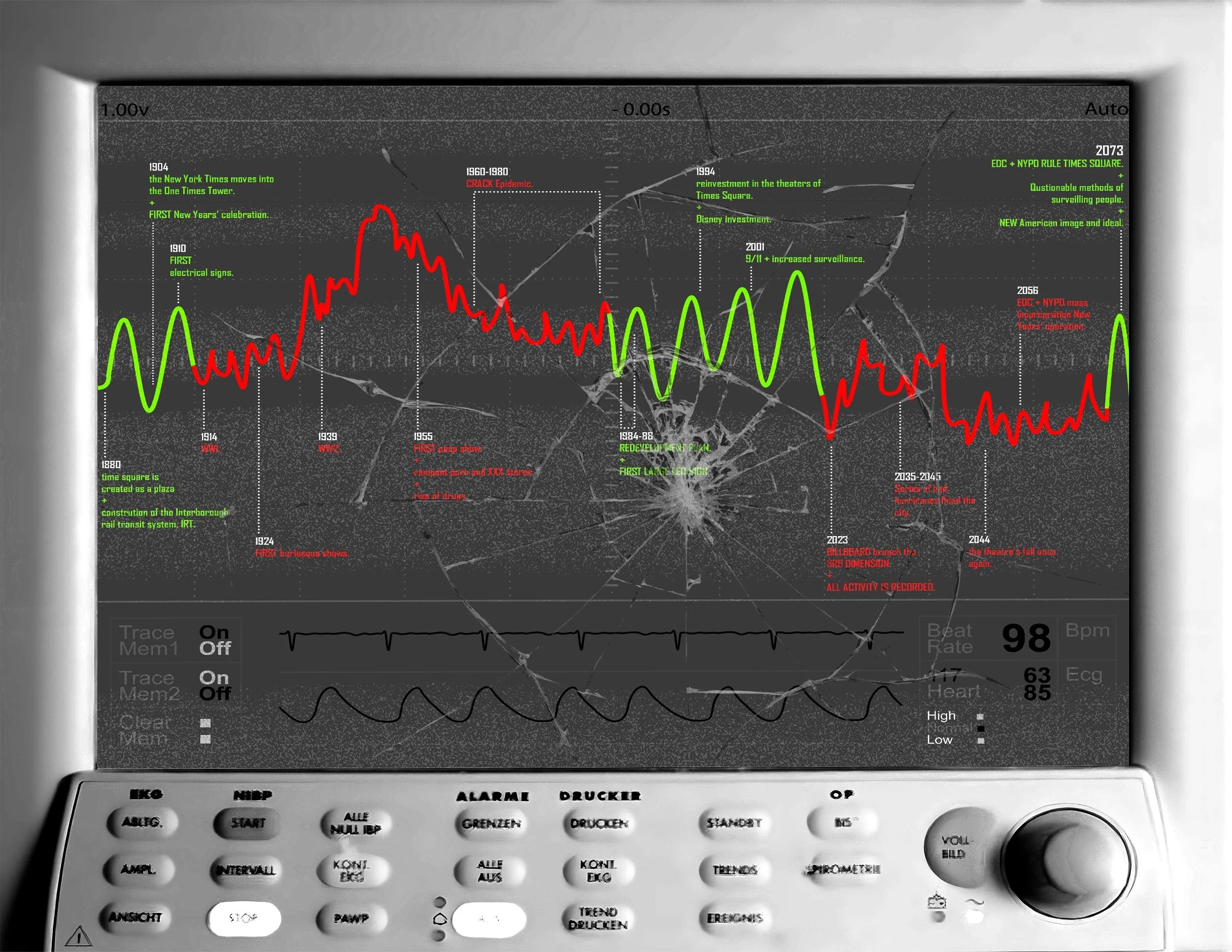
It is 2073 and it’s been nearly 40 years since Times Square saw its last glory days. Like every neighborhood, it too has had its cycles, its ups and downs.
After a series of hurricanes and severe flooding, the area has seen a steady decline into its old habits and vices. It started with the transportation systems. They were the first to flood, were met with zero maintenance, and became thriving squatting settlements. Slowly, all the deviant characters and their acts made their way to the surface.
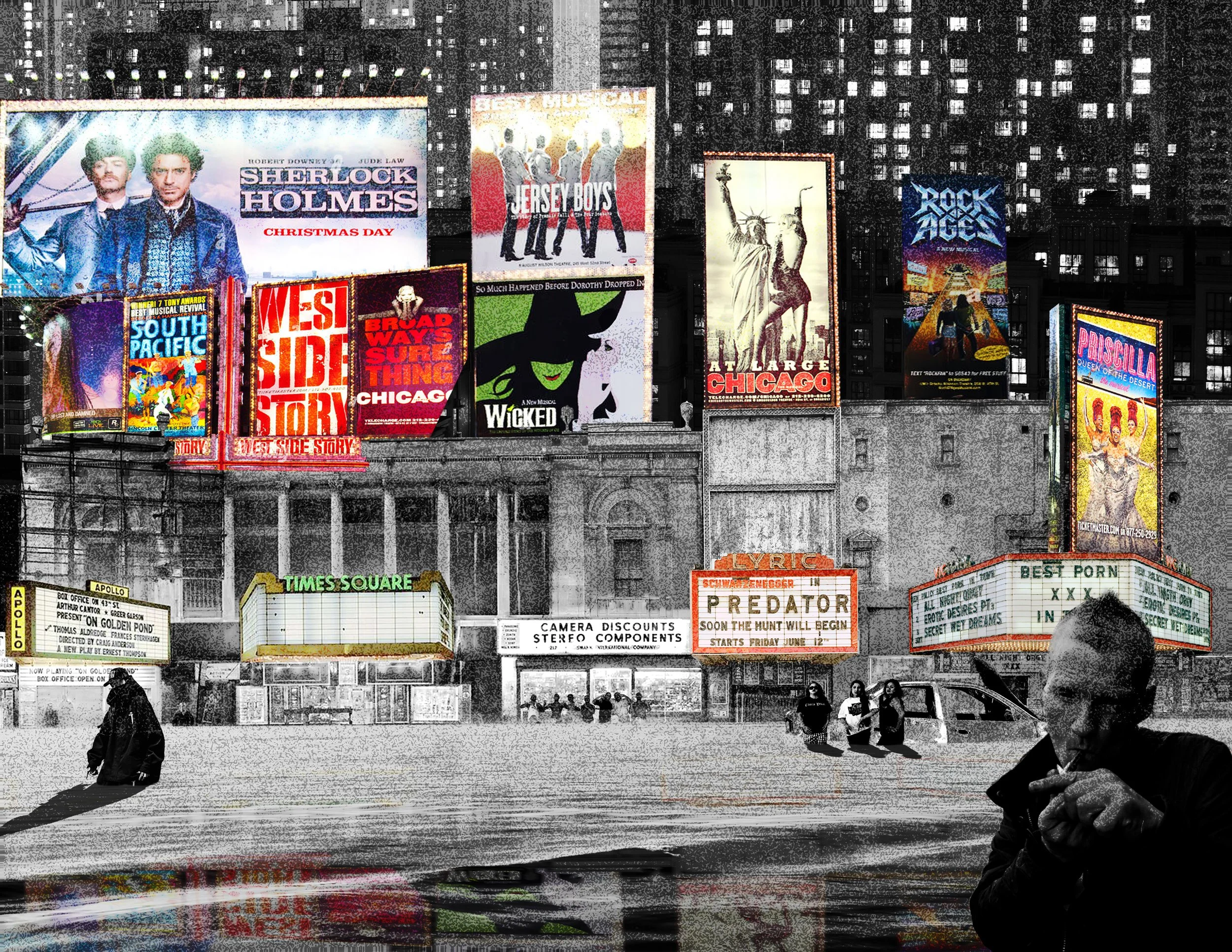
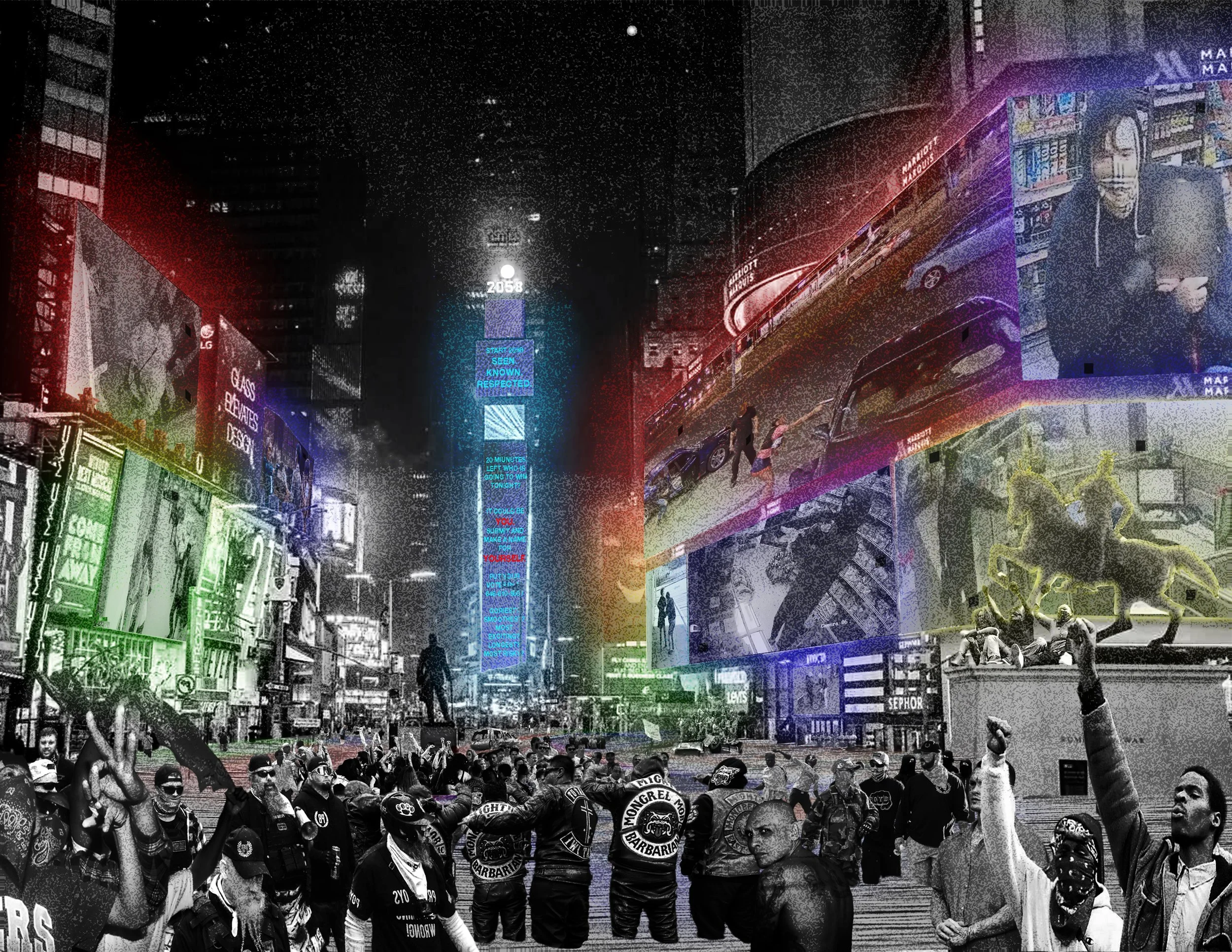
The theaters were second to go. In the early 1990s they had somehow cured themselves from the perverted thirst of soldiers on break from the world wars and had become jubilant acts of professional theater for kids and adults alike. Since then, they have slipped back into low morals and degenerate behavior. The squatters of these theaters were fiending like they once had and were on the prowl for the next “hit”. Except this time, it had nothing to do with a drug epidemic. The fiends didn’t tread through the calf-high water to shoot up or smoke pipe, they were after a fresh start, a place to make a name for themselves. See, after the first floods the scum of the city ran for safety to the ornate theaters.
The buildings’ lights shimmered on the water like an oasis, only it turned out to be a mirage [Fig. 1]. There, the hardest of criminals, the heaviest of drug users, the worst of the worst, gathered and formed gangs, sisterhoods, and mobs.
The city saw an opportunity. The EDC, originally the Economic Development Corporation, now the E-dentification Data Collector, conjured a plan to document all of these characters using the already existent billboards. On the New Year’s Eve of 2058, the NYPD, with its headquarters already at the base of the abandoned 1 Times Tower, partnered up with the EDC for the city’s biggest combing of criminal activity. The stunt involved spreading the rumor of an illegal New Year’s ball drop, an activity forgotten after Hurricane Selma in 2042. The idea was that the billboards would broadcast some of the most violent, deranged, and morally questionable behavior recorded throughout the city over the past year. Some petty crimes, others egregious acts of violence [Fig. 2]. The crimes and their perpetrators would be given awards, such as the poorest and smoothest executions, the goriest, the most elaborate, and so on. In other words, these deviant characters would be given their 15 minutes of fame, like models, actors, and brands had been given theirs in Times Square’s golden age.
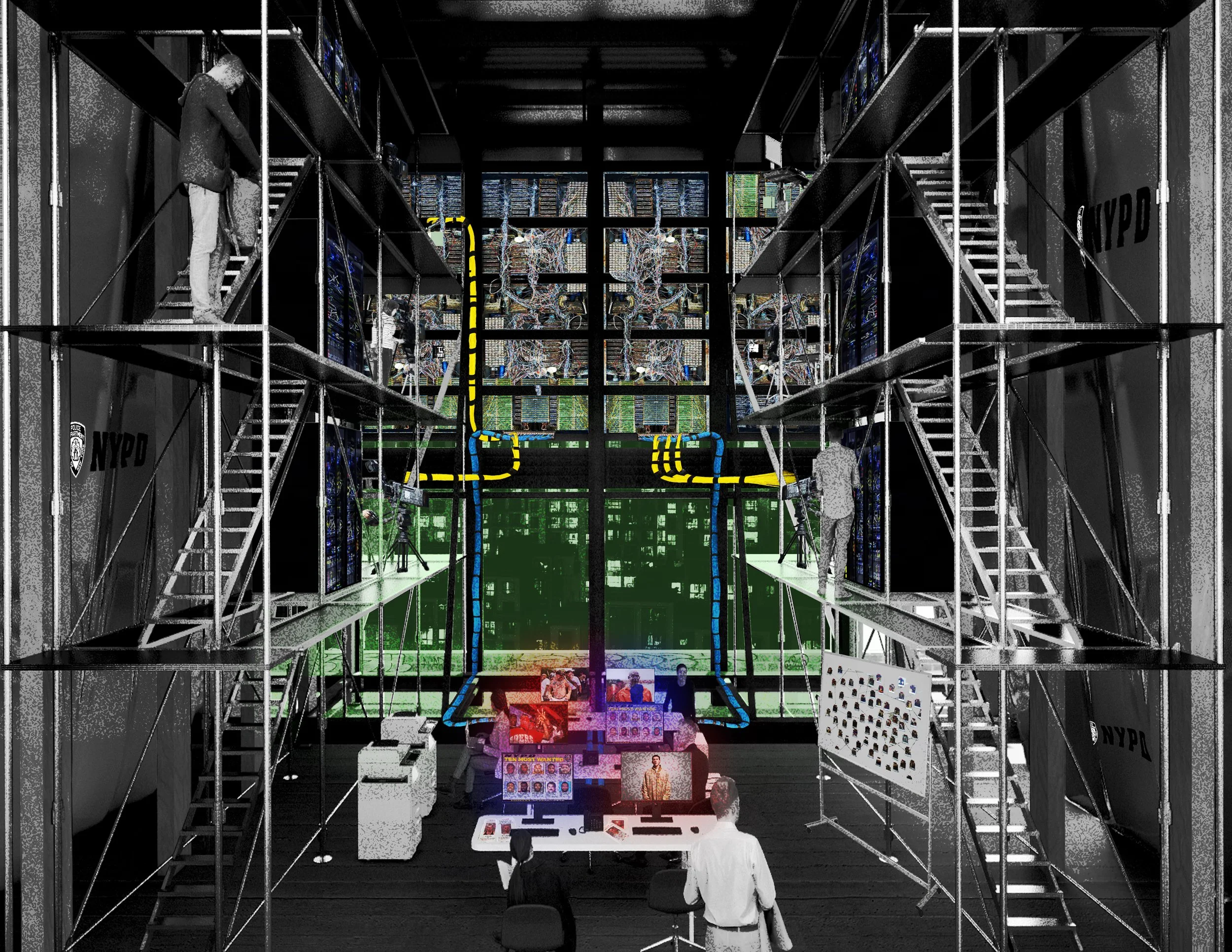
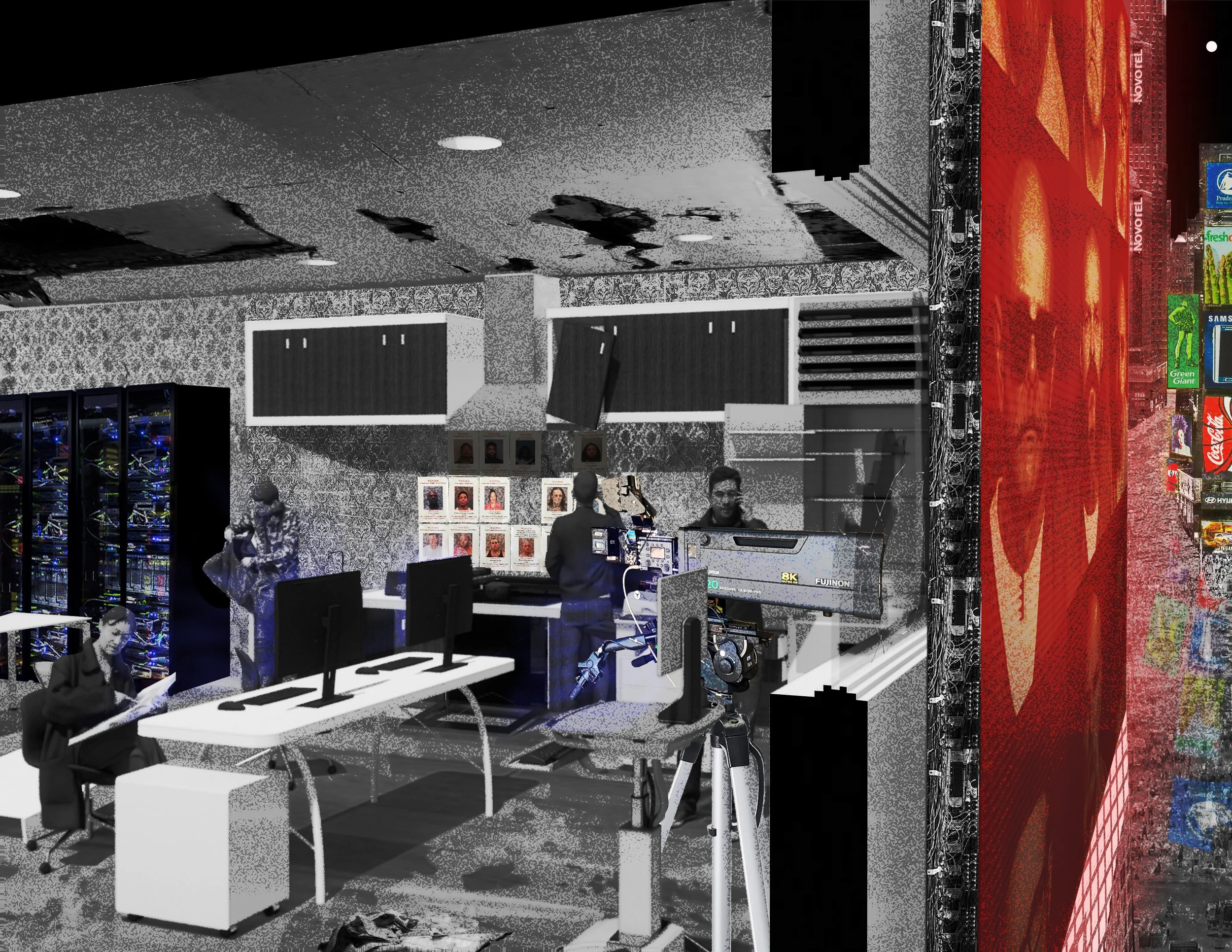
The NYPD, the EDC, and CY3ERPUNK Architects designed surveillance outpost. Each had a recording studio, live data monitors and processors, and the most high-tech cameras. These were all placed in the spaces forgotten behind each billboard Times Square had to offer. Some crept and leeched into vacant apartments, others had the total liberty of empty rooftops [Fig. 3,4]. It was done in total secrecy and right under the nose of all the criminal activity. These were and remain the most expensive stakeout vans that have never moved and to this day only stakeout one place in the whole city.
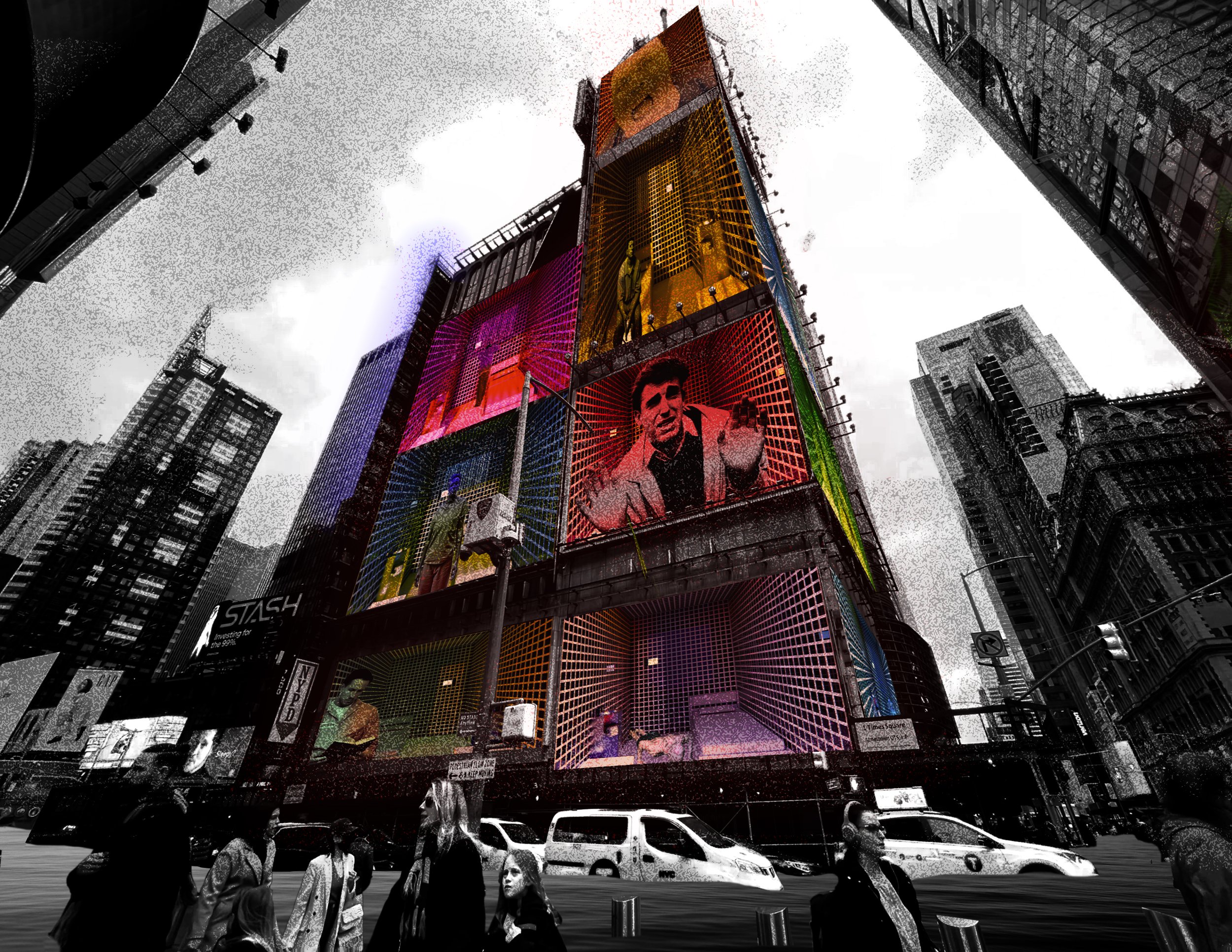
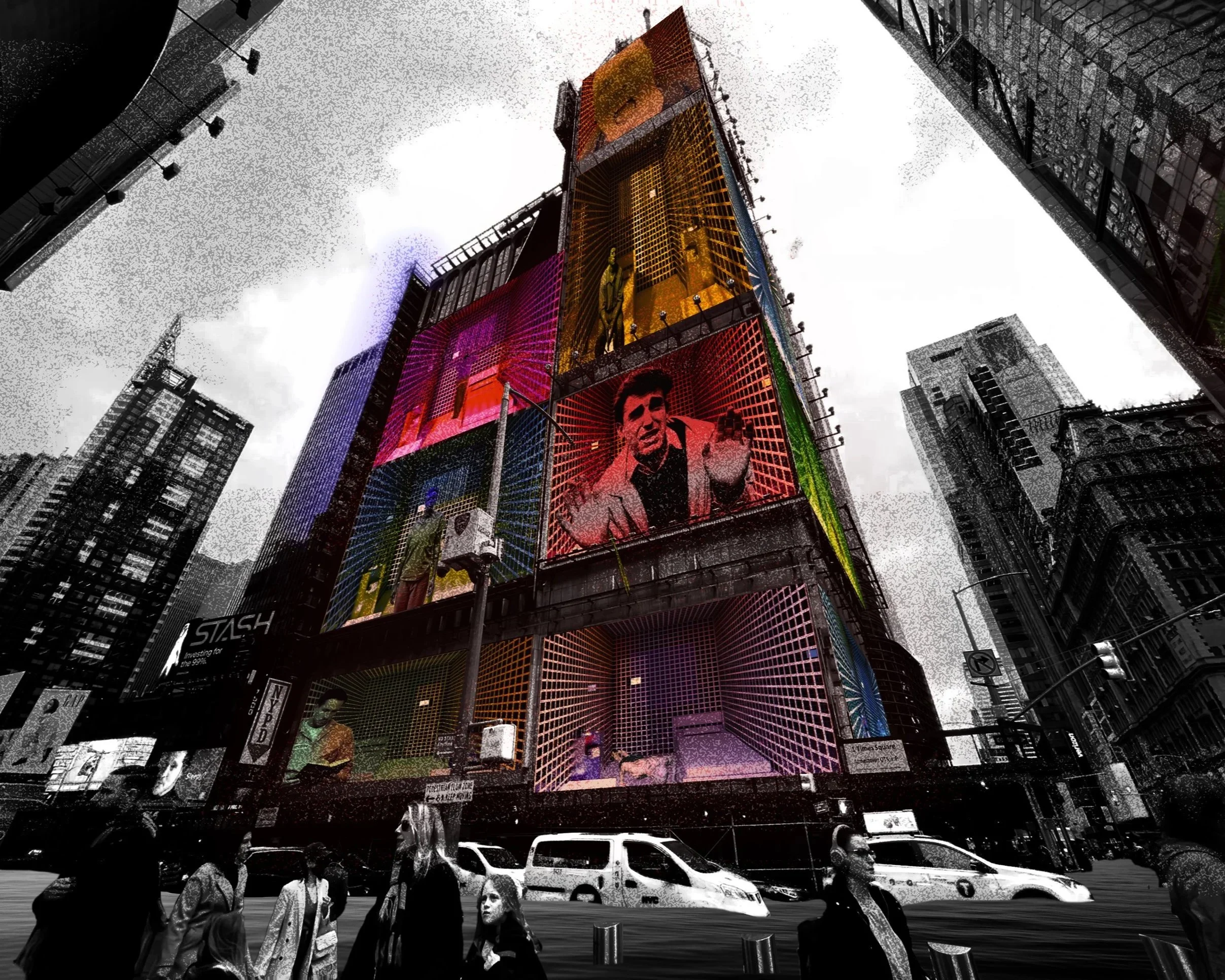
The helm of this digital crusade is the 1 Times Tower. The tower had originally served as the source of everything a New Yorker needed to know about the current times, but it had sold its soul in the early 2000s to electronic branding billboards, and completely dedicated itself to the dissemination of an imposed reality as its inside decomposed and rotted. It had laid abandoned and rotting for so long but it occurred to CY3ERPUNK Architects, “what better place for a prison then in the heart of the city, in plain sight, a glaring beacon of justice, completely wrapped in billboards.” The architects retrofitted the building to be the incarnation of everything wrong with American capitalist dream. This time, 1 Times Tower had doubled down on its soul selling and had horrendously evolved into a 26 storey prison and personal data collection center for the surveillance and subjugation of society.
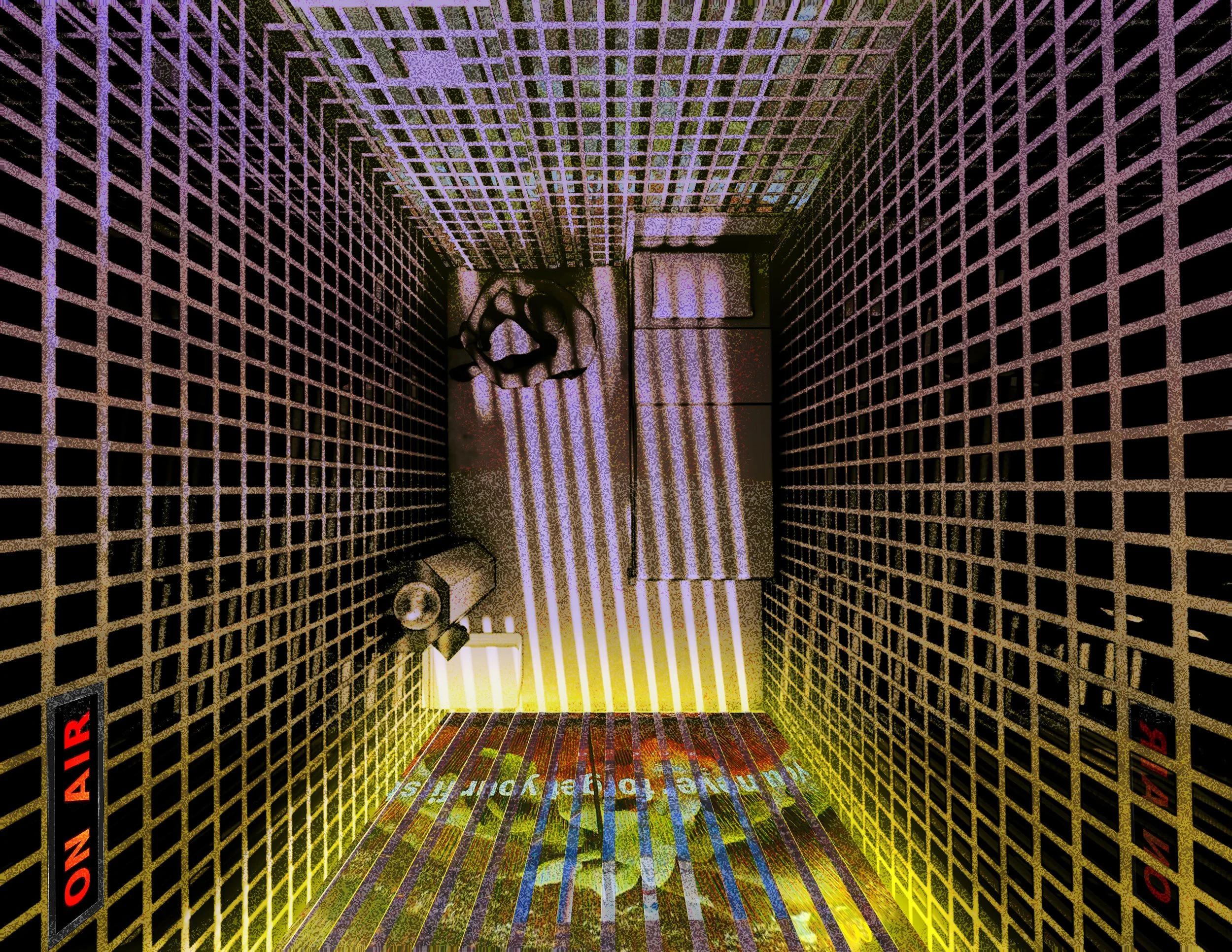
The prison was built like a digital panopticon, flipped inside out. The lantern that blinded the prisoners is no longer at the center of the architecture, but along the outer perimeter. The billboards already encasing the tower would restrict the prisoners’ views out and would in turn disorient them with flashes of text, color, and shape [Fig. 5]. The constant changing of ads and their timely rotations led to the development of billboard rehabilitation. Dependent on behavioral responses to the rehab, the prisoners were given 30 seconds, 1 minute, or 3 minutes to broadcast themselves, from their brightly lit cells to the public. The only signal they were given was a mocking “live recording” sign at the top right of their screen wall.
The products have been delirious. Each prisoner reacts differently to their 15 minutes of fame. Some show re-morse, others plead for an uprise, others hide from a camera they can’t find [Fig. 6].
It has become a real crowd gatherer, especially amongst the youths that show up to burn some time and poke fun, as if they were at a zoo. For tourists, it has become the realist of reality television. Once broadcasting the late show with David Letterman, the comedy was now in the fact that these prisoners are the tourist attraction of the newest 42nd St. They are the plays that once spurred Times Square out of old cycles of vice. 15 Minutes of human degradation, supposedly done in the name of justice.
In the time they’re not being broadcasted, the prisoners’ ghostly outlines wander aimlessly within the confines of the billboard as a constant reminder to pedestrians that they are being surveillanced. Most pedestrians steer clear, in fear that the billboards might pick up on their infringement on the law.
-
![]()
[Fig. 1]
-
![]()
[Fig. 2]
-
![]()
[Fig. 3]
-
![]()
[Fig. 4]
-
![]()
[Fig. 5]
-
![]()
[Fig. 6]